
What is Risograph printing?
And why do I use it?
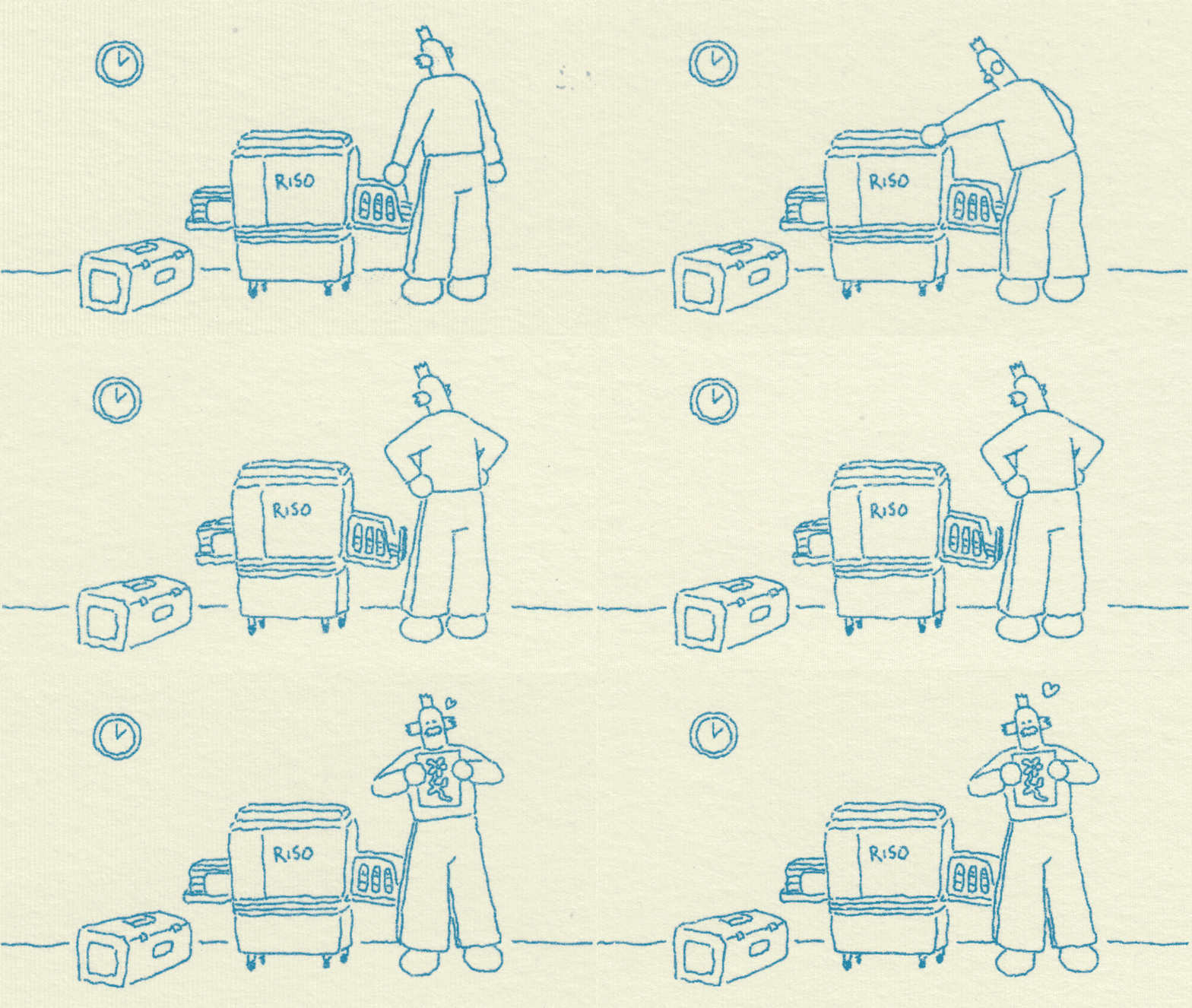
Most of the work that is available in my shop was printed on a risograph machine. This is a special type of printer made by the RISO Kagaku Corporation in Japan. The stencil.wiki site has a good, brief technical explanation of how the machine works–a very helpful resource if you are interested in learning more about risograph printing beyond my post. There are many interesting facets to risograph printing and its relationship to the art of printmaking, but what I want to do here is break down why risograph printing appeals to me, as an artist.
A color separated image
1. Color
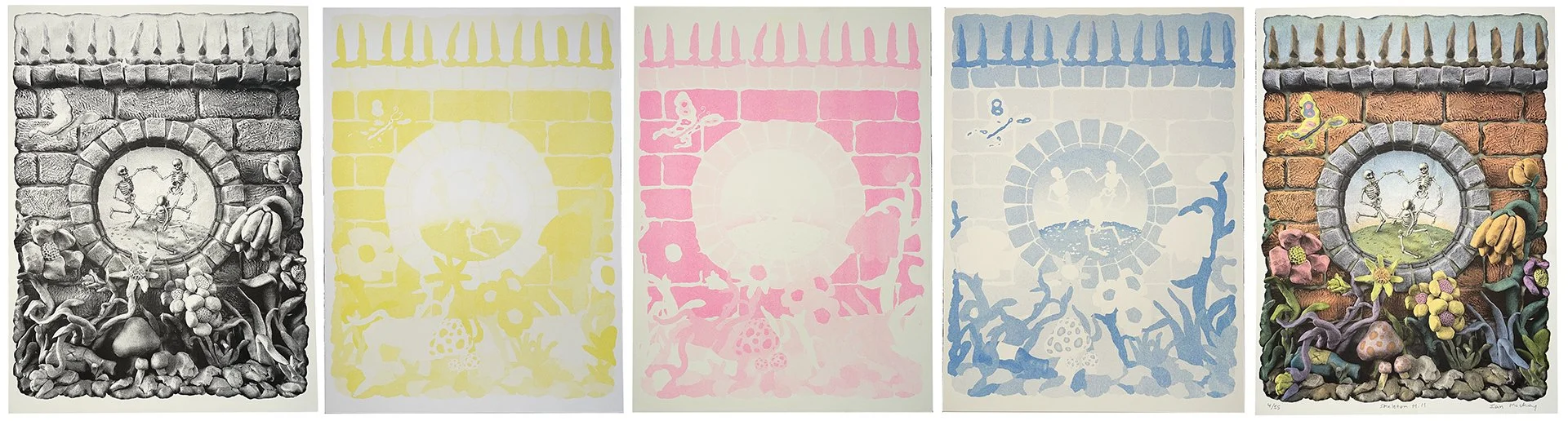
A risograph machine prints one color ink at a time. In this way, it is very similar to screen printing. If you see a risograph print where the image seems to be only one color, maybe blue like this Hollyhock print, it is probably only printed in blue ink. That means the paper passed through the machine one time, and a blue ink drum applied the ink to it.
If the same image were printed on an inkjet printer, the blue color would be produced by some combination of four different ink colors (cyan, magenta, yellow, and black), overlaid in a dot pattern at varying densities. And the paper would only pass through the machine one time, with all four inks applied at once.
If you see a risograph print that has a range of colors, like this Green House print, it is composed of more than one ink color. The Green House is printed in three inks: yellow, fluorescent pink, and blue. That means the paper passed through the machine three different times: once with the yellow ink drum inserted, once with the fluorescent pink drum, and once with the blue drum. The three inks are overlaid in a halftone dot pattern at different densities, like in a CMYK print.
Why this matters:
The risograph process breaks an image into its component colors, which allows an artist like me to have greater control over them. If I want to print an image in one color ink, there is a range of risograph inks available to me that can achieve a vibrancy beyond what is available with a combination of CMYK. If I want to print an image that has a wider range of colors, I can use multiple risograph inks to create alternative combinations and gamuts unavailable to CMYK. I like to design my prints in color separated layers on my computer, so I can anticipate how the ink colors I use will combine when printed. This method makes it easy for me to adjust the value of one color in one part of an image, or change it out for another ink color to see how it will look. In short, knowing the colors will be separated when I print encourages me to experiment with them as I design: the separation between colors gives me the space to exert my artistic preferences.
grain-touch halftones
2. Dots
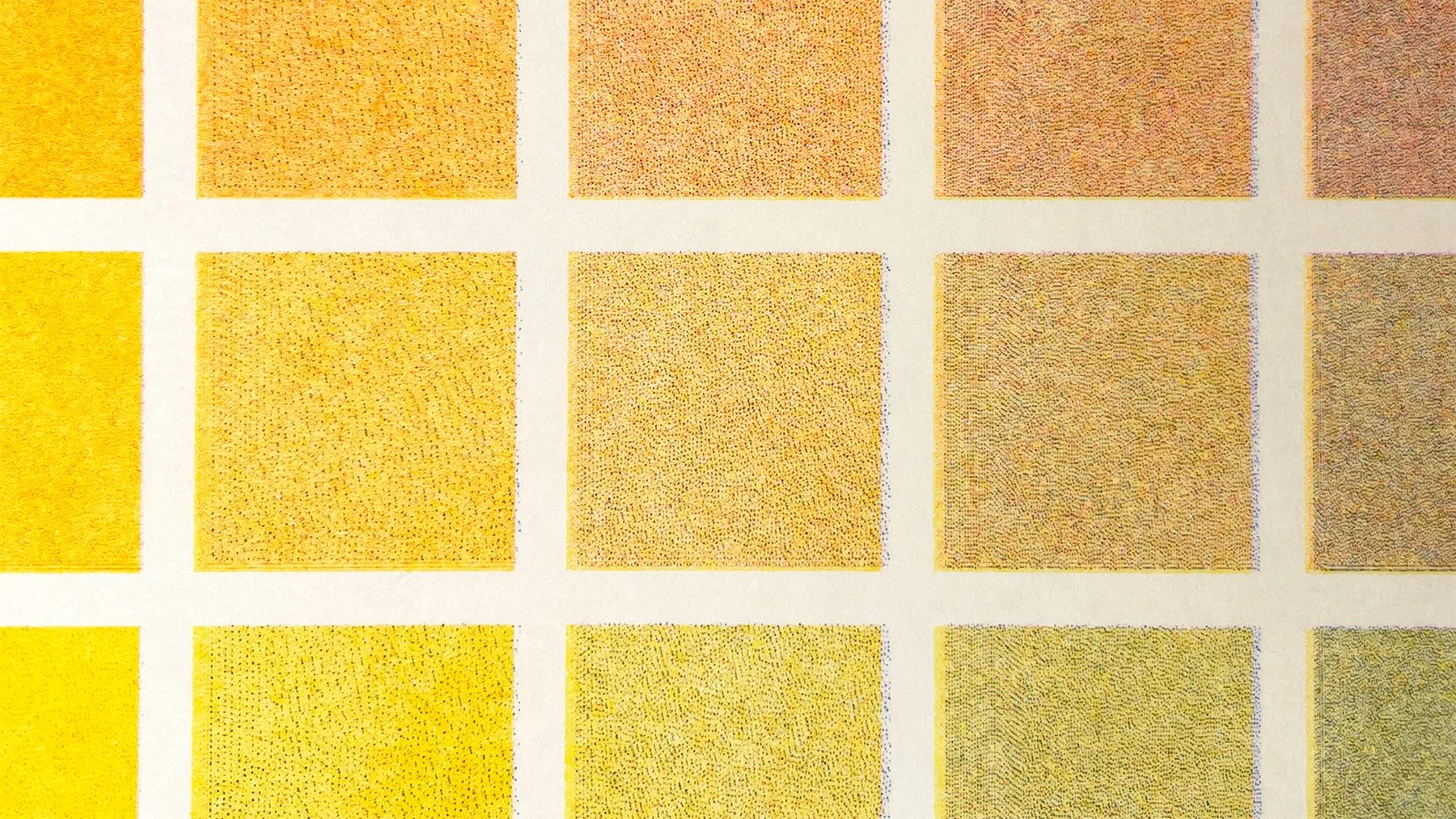
A risograph machine can print ink in varying densities, from no ink to 100% saturation. To achieve any density between 0 (no ink) and 100 (full ink coverage) it uses a halftone dot pattern. The risograph machine allows you to choose between 2 different halftone dot patterns: “screen-covered” and “grain-touch.” Screen-covered is the classic halftone pattern that is often used in screen printing. It is also called AM/XM screening. Depending on the desired density, it looks like a regular distribution of tiny circles of ink surrounded by ink free areas of paper or tiny circles of ink free paper surrounded by areas of ink. Grain-touch is also known as stochastic or FM screening. It uses a pseudo-random distribution of dots to achieve variations in tone. They look like tiny grains of ink rather than circles.
Why this matters:
The risograph grain-touch half tone pattern allows for very smooth tone gradations in printed images. This is a quality that is not often easy to achieve in other forms of printmaking; the subtlety and softness it brings to rendering is usually associated with lithography. Observing this special ability led me to experiment with the depiction of the sculptural clay forms that you can see in the Hollyhock print. I realized that the risograph could render the clay forms and textures to great effect, conveying much of the richness of the actual three dimensional clay objects.
I should note that FM screening is used by some screen printers as well, although it is much rarer than the typical AM/XM screening. FM screening is more difficult to deploy with success when screen printing and requires a great precision of preparation and technique. But I have the good luck of working with a screen printer who has the talent and skill to successfully print FM halftones: Poppy Press of California. We have collaborated to translate some of my risograph print designs to larger screen prints using FM screening. This Monterey Cypress print is an example of a screen print that uses FM screening to convey my clay sculpture style.
printing at speed
3. Speed
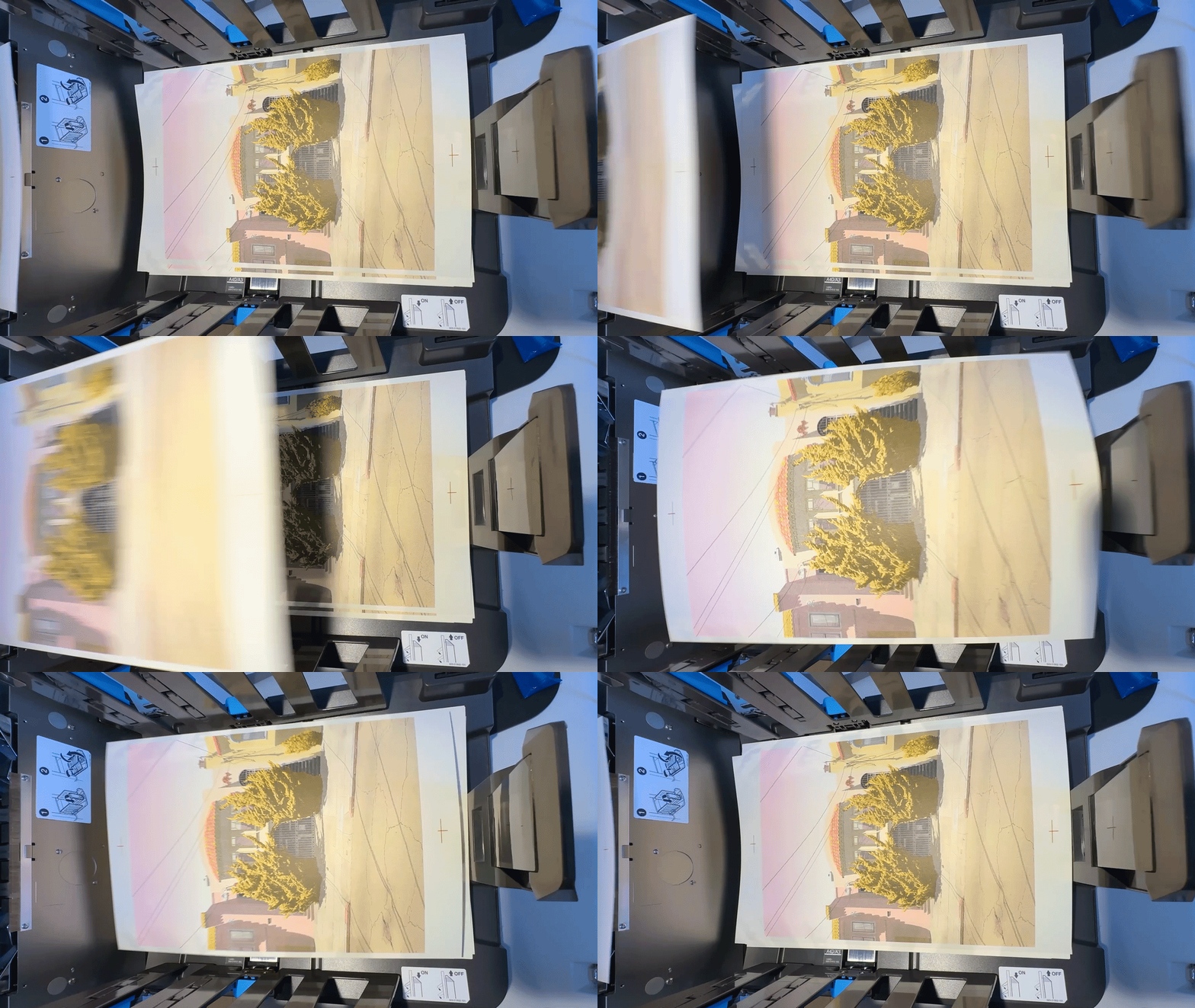
A risograph machine prints very quickly. Within a matter of seconds, it will burn a stencil of your image into a “master” film, apply the master to the ink drum, pull a sheet of paper into the machine and across the drum, and push ink through the stencil onto the paper. The paper emerges from the machine, and you can see your printed image.
Compare this to screen printing, another stencil-based printing technique: hours might pass between the moment you first apply the light sensitive emulsion to the screen and the moment when you will see your first printed image. Inkjet printing fares better in comparison, it takes several seconds to print an image.
But a risograph machine is technically known as a “duplicator.” It produces the first printed image in a few seconds, only to produce every additional duplicate print in a fraction of a second, hundreds within a few minutes. This is why the risograph is often described as “kinda like a Xerox machine.” Screen printing is also intended to produce duplicates, but even the fastest screen printer will still need several seconds to pull each print. And I doubt any screen printer can produce hundreds in under five minutes. An inkjet printer will take the same amount of time to produce a duplicate that it takes to produce the original.
Why this matters:
Designing for print involves a lot of anticipation. You have to make guesses at how your design will look when it is printed and make choices and aesthetic judgments based on that guesswork. As I mentioned in the “Color” section, I design my prints in color separated layers on my computer, which allows me to approximate what the final print will look like. This saves me a lot of trouble, but it only gets me to about 90% certainty that what I have designed will look good to me when I print it. There will always be differences between an image that projects itself into your eyes via RGB light from a computer screen and one that bounces daylight off of pigmented ink on paper.
The speed of the risograph allows me to produce test prints quickly so that I may evaluate them and determine any adjustments that I want to make to the design. Even if the adjustments take some time, I know that the production of a new master stencil and print will take less than a minute, as opposed to hours or more with other types of printing. The costs in time and materials are minimal, so I am encouraged to adjust and test until I am satisfied with the look of the print. At this point, with years of experience, my design instincts are usually pretty good, but there are still times when after test printing, I realize the design needs drastic alterations. The speed of the risograph frees me to judge and act accordingly.
The other upside of the risograph machine’s speed is that it facilitates the production of books. Books are full of pages and what are pages but double-sided prints? The economics of bookmaking are complicated and merit a separate discussion, but the risograph’s duplicative power makes printing an edition of a few hundred books feasible for an artist like me.
Conclusion
Risograph printing is a crucial technology for my artistic practice. It has facilitated my experimentation with color and form in the design and production of my artwork. And I can leverage its productive power and efficiency to free me from drudgery and devote more time to aesthetic priorities.